Check the Children's Barred List - Architecture
Check the Children's Barred List (CBL) is a single Rails monolith that lets employers, agencies and local authorities check whether someone appears on the Children's Barred List. This document is the high-level design: what the service is made of, what it talks to, and where to look next.
Overview
Users sign in with DfE Sign-in and search by last name and date of birth. TRA support staff load the list itself by uploading a CSV through the support interface, so the data is a point-in-time snapshot, not a live feed.
CBL has no upstream API. It doesn't call the TRS (formerly DQT) API or read any teaching record, and its outbound integrations are DfE Sign-in, BigQuery, Sentry and Logit.
The stack is Ruby 3.4, Rails 8.1 and Puma, using the GOV.UK Design System through govuk-components and govuk_design_system_formbuilder, with Propshaft, jsbundling-rails and cssbundling-rails for assets. It runs in the Teacher Services Cloud AKS clusters — review, test and preproduction in the test cluster, production in its own — as hosting and observability sets out.
Container diagram
This is a C4 container view: the runnable things CBL is made of, the people who use them, and the systems they depend on. It leaves out uptime monitoring — see hosting and observability for that.
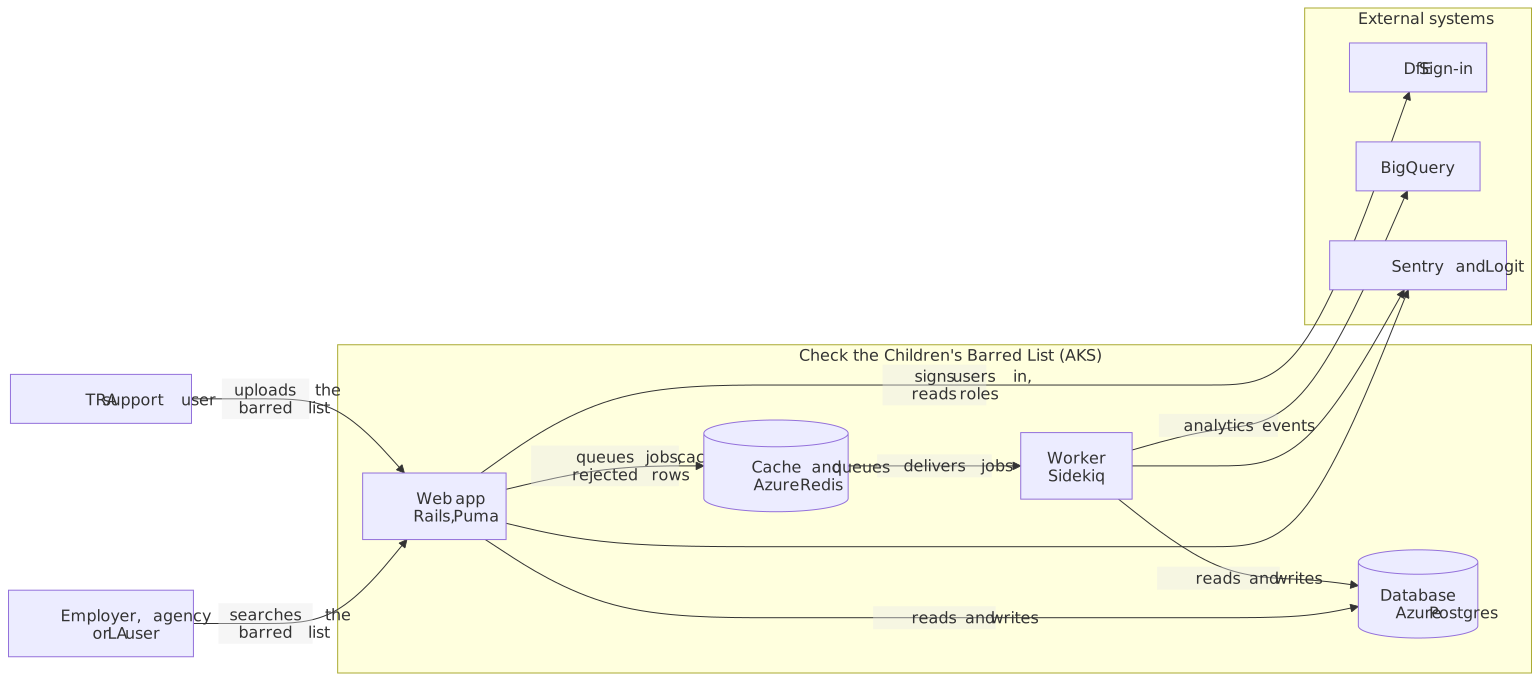
The source is images/container-view.mmd; images/README.md has the steps for regenerating the SVG.
The containers
Web app
The Rails application, running under Puma. It serves the search journey (the form at / and /search, the result at /result), the DfE Sign-in flow (/sign-in and /auth/dfe/*), the support interface at /support, which covers CSV uploads, role management and feature flags, and the feedback, terms and conditions, accessibility and cookies pages. okcomputer serves the health check at /healthcheck. See authentication for the sign-in and authorisation layers.
Worker
The same Docker image, started with bundle exec sidekiq -C ./config/sidekiq.yml — see the worker_application module in terraform/aks/application.tf. It serves four queues, critical, default, low and analytics, and retries a failed job once (config/sidekiq.yml).
sidekiq-cron runs the scheduled jobs, loading config/schedule.yml when the worker starts:
| Job | Schedule | Purpose |
|---|---|---|
DfE::Analytics::EntityTableCheckJob |
Daily 00:30 | Sends table checksums to BigQuery |
TrimSessionsJob |
Daily 04:00 | Prunes expired rows from the sessions table |
Database
An Azure Postgres flexible server, provisioned from the shared teacher-services-cloud module in terraform/aks/databases.tf. It holds the barred list entries, DfE Sign-in users and their sessions, role codes, search logs, feedback, feature flags, and the Rails sessions themselves — CBL stores sessions with activerecord-session_store (config/initializers/session_store.rb), which is why the sessions table needs nightly trimming.
The models encrypt personal data with Active Record encryption, and some columns are deterministic so that they can be searched. See encryption for the constraints that places on the service.
Cache and queues
An Azure Redis instance, also from terraform/aks/databases.tf. It backs the Sidekiq queues and holds one piece of application state: the rows a CSV upload rejected, cached for an hour under the upload's file hash so that the preview page can show them (app/services/failed_childrens_barred_list_entries.rb).
Where to go next
- Data flows — how the barred list gets in, and what happens during a search
- Authentication — the basic auth gate, DfE Sign-in, and support access
- Hosting and observability — environments, deployment, monitoring
- Encryption — how PII is protected and what that constrains
- Disaster recovery — what to do when the database is lost or corrupted
- AKS cheatsheet — day-to-day cluster commands
Architecture Decision Records (ADRs)
We keep track of architecture decisions in Architecture Decision Records (ADRs).
Use rladr to generate the boilerplate for a new record:
bin/bundle exec rladr new title